Getting Started with the Cisco ACI Integration for NetBox
The Cisco ACI integration is currently in customer preview. Contact support@netboxlabs.com if you have not already been onboarded.
This guide walks you through setting up the Cisco ACI Integration for NetBox.
- Prerequisites
- Host Requirements
- NetBox Setup
- Agent Setup and Configuration
- Expected Output
- View and Apply Discovered Data in NetBox Assurance
- View the Cisco ACI Data in NetBox
- Additional Resources
Prerequisites
Before you begin, ensure you have the following:
- NetBox Cloud or NetBox Enterprise with NetBox Assurance
- Orb Agent Pro credentials (required to download the integration agent image)
- Cisco APIC with REST API access and a user account that can read fabric inventory
- Host system with Docker support
- Network connectivity between your host and both your NetBox instance and the APIC
Host Requirements
System
- Operating System: Linux, macOS, or Windows with Docker support
- Memory: Minimum 2 GB RAM (4 GB recommended)
- Storage: 1 GB free disk space
- Docker: Version 20.10 or later
Network
- Outbound gRPC/gRPCS access to Diode on your NetBox instance (typically port 443 for gRPCS)
- Outbound HTTPS access to your Cisco APIC (typically port 443)
- DNS resolution for both NetBox and APIC hostnames
- Firewall rules configured to allow the above connections from your agent host
NetBox Setup
Generate Diode Client Credentials
- Log in to your NetBox instance.
- Navigate to Diode → Client Credentials.
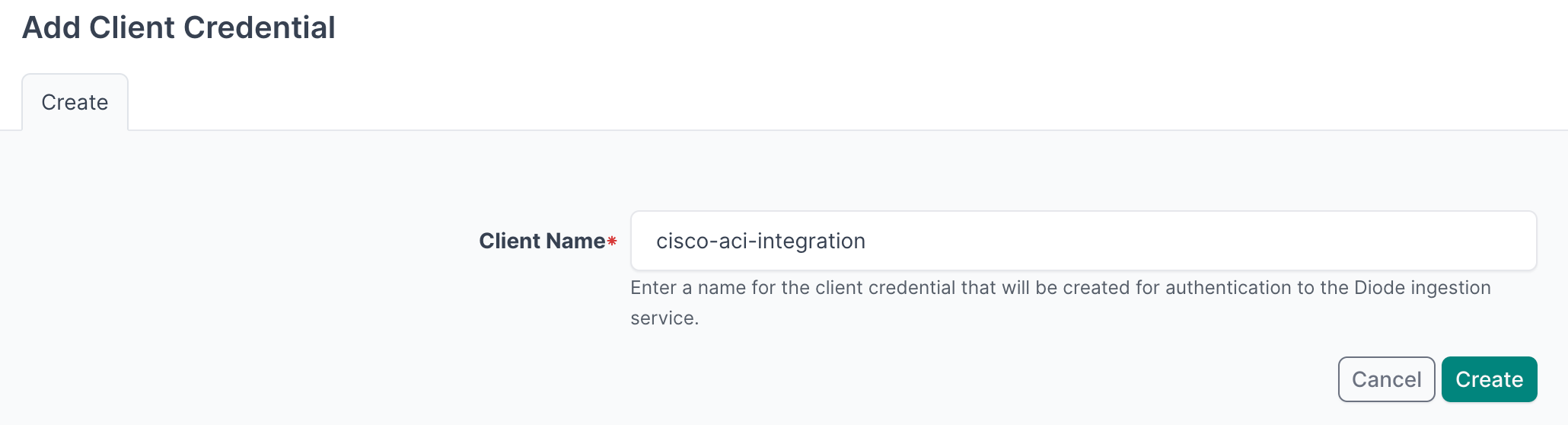
- Click + Add a Credential.
- Enter a descriptive name (for example, "Cisco ACI Integration").
- Click Create.
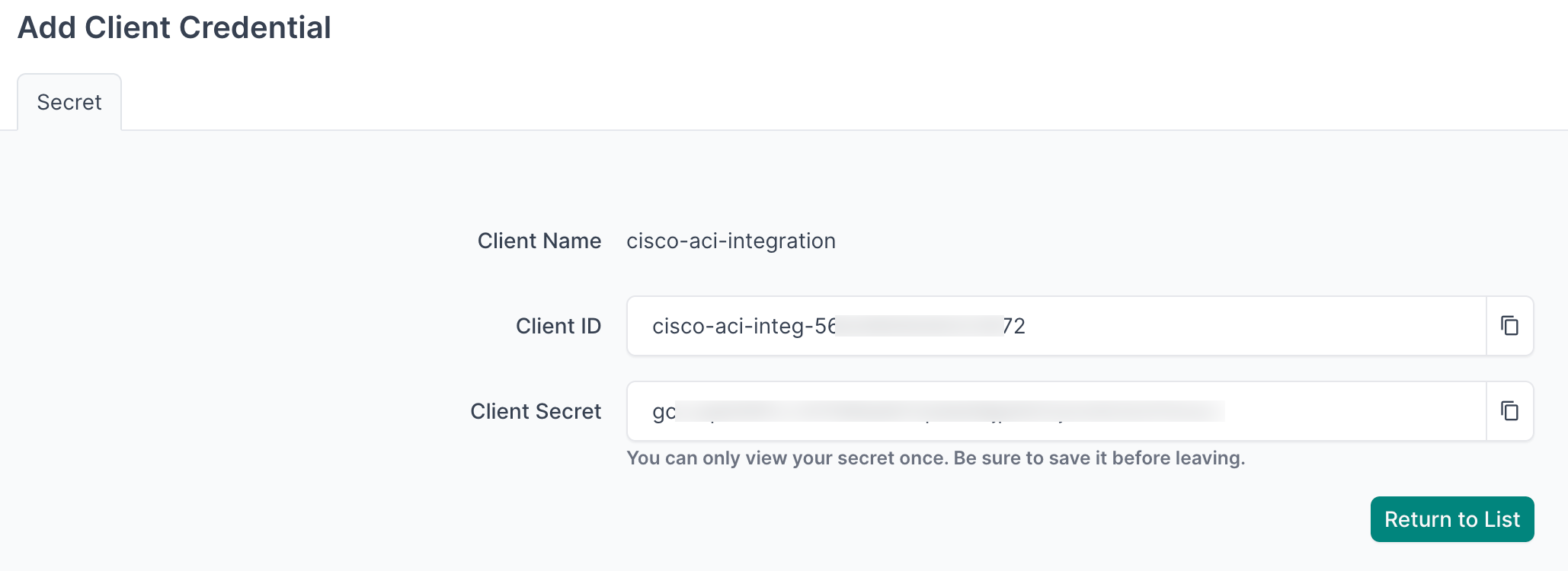
- Important: Copy and securely store the Client ID and Client Secret - you will need them in the agent configuration.
- Navigate to Diode → Settings.
- Copy the Diode target value - you will use this in the agent configuration file.

Agent Setup and Configuration
Step 1: Authenticate to the NetBox Labs Image Registry
From your host machine, authenticate to the NetBox Labs registry using the CUSTOMER-IDENTIFIER and token provided by the NetBox Labs team:
docker login quay.io -u netboxlabs+<CUSTOMER-ID> -p <TOKEN>
Example session:
% docker login quay.io -u netboxlabs+org-abc123def456 -p <token>
Login Succeeded
Then pull the agent image:
docker pull quay.io/netboxlabs/orb-agent-pro:develop
Step 2: Configure the Agent
- Create the configuration file:
touch agent.yaml
- Edit the configuration file and add the following. Replace
grpcs://your-instance.netboxcloud.com/diodewith the value from Diode → Settings → Diode target in the NetBox UI:
orb:
  config_manager:
    active: local
  backends:
    worker:
    common:
      diode:
        target: grpcs://your-instance.netboxcloud.com/diode  # Get this value from Diode > Settings > Diode target
        client_id: ${DIODE_CLIENT_ID}
        client_secret: ${DIODE_CLIENT_SECRET}
        agent_name: cisco_aci_01  # Use a meaningful name to identify this agent
  policies:
    worker:
      cisco_aci_worker:
        config:
          package: nbl_cisco_aci
          schedule: "0 */6 * * *"  # Every 6 hours. Set your desired schedule (see examples below)
          timeout: 5
          APIC_URL: ${APIC_URL}          # APIC controller URL, e.g. https://apic.example.com
          APIC_USERNAME: ${APIC_USERNAME}
          APIC_PASSWORD: ${APIC_PASSWORD}
          SITE_NAME: "ACI Fabric"        # NetBox site name for this fabric (default: "ACI Fabric")
          BOOTSTRAP: false               # Set to true for initial setup only
          # SKIP_SSL: false              # Set to true to disable SSL certificate verification
        scope:                           # Required — leave empty to ingest all tenants and pods
        # scope:                         # Or restrict ingestion to specific tenants or pods:
        #   tenants:
        #     - Production
        #   pods:
        #     - "1"
MultiPOD fabrics: If your ACI fabric spans multiple pods in physically separate datacenters, use POD_SITE_MAP instead of SITE_NAME to assign each device to the correct site:
          APIC_URL: ${APIC_URL}
          APIC_USERNAME: ${APIC_USERNAME}
          APIC_PASSWORD: ${APIC_PASSWORD}
          POD_SITE_MAP:
            "1": "Datacenter A"
            "2": "Datacenter B"
Each pod maps to a NetBox site name. The integration creates one site per distinct name and assigns every device - including APIC controllers - to the site matching its pod. SITE_NAME is ignored for device site assignment when POD_SITE_MAP is configured. See MultiPOD Site Mapping for full details.
The schedule field uses cron syntax. Common examples:
"*/30 * * * *"- Every 30 minutes"0 * * * *"- Every hour"0 */6 * * *"- Every 6 hours"0 2 * * *"- Daily at 02:00
Bootstrap Mode (First-Time Setup)
Bootstrap mode creates the custom fields and static entities in NetBox that the integration requires before the first full fabric sync. Run it once on initial setup, then disable it for all subsequent runs.
What bootstrap mode creates:
- ACI-specific custom fields on Device, Interface, VRF, Prefix, and IPAddress objects
- A "Cisco" manufacturer entry
- Device roles: APIC Controller, Spine Switch, Leaf Switch
Configuration:
config:
  BOOTSTRAP: true  # Set to true for initial setup, false for regular operation
First-time run process:
- Set
BOOTSTRAP: truein your configuration. - Run the agent and monitor the output for
executed successfully. - Stop the agent by pressing
Ctrl+Conce you seeexecuted successfully. - Apply the deviations in NetBox Assurance (see Apply Deviations below).
- Set
BOOTSTRAP: falsefor all future runs.
Optional - Dry Run Mode
The agent can run in dry run mode, which writes discovered data to a JSON file instead of sending it to NetBox. This is useful for troubleshooting or sharing data with the NetBox Labs support team.
Add the following to the diode section of your configuration:
      diode:
        dry_run: true
        dry_run_output_dir: /opt/orb/  # Output file is written to this directory
Step 3: Run the Agent
Run the agent to synchronize ACI fabric data into NetBox.
Method 1: Set Environment Variables Manually
- Export Diode credentials:
export DIODE_CLIENT_ID="your-client-id"
export DIODE_CLIENT_SECRET="your-client-secret"
- Export APIC credentials:
export APIC_URL="https://apic.example.com"
export APIC_USERNAME="your-apic-username"
export APIC_PASSWORD="your-apic-password"
- Run the agent:
docker run \
  -v $PWD:/opt/orb/ \
  -e DIODE_CLIENT_SECRET \
  -e DIODE_CLIENT_ID \
  -e APIC_URL \
  -e APIC_USERNAME \
  -e APIC_PASSWORD \
  quay.io/netboxlabs/orb-agent-pro:develop \
  run -c /opt/orb/agent.yaml
Method 2: Use a .env File (Recommended)
- Create a
.envfile:
touch .env
- Edit the
.envfile and add the following:
## NetBox Diode credentials
DIODE_CLIENT_ID=your-client-id
DIODE_CLIENT_SECRET=your-client-secret

## Cisco APIC credentials
APIC_URL=https://apic.example.com
APIC_USERNAME=your-apic-username
APIC_PASSWORD=your-apic-password
Replace the placeholder values with your actual credentials:
your-client-idandyour-client-secretfrom the NetBox Diode setuphttps://apic.example.comwith your APIC hostname or IP addressyour-apic-usernameandyour-apic-passwordwith your APIC credentials
- Run the agent:
docker run \
  -v $PWD:/opt/orb/ \
  --env-file .env \
  quay.io/netboxlabs/orb-agent-pro:develop \
  run -c /opt/orb/agent.yaml
Add .env to your .gitignore file to avoid committing credentials to version control:
echo ".env" >> .gitignore
Expected Output
After starting the agent, you will see log output as the integration queries the APIC and sends data to NetBox:
{"time":"2025-07-20T15:15:01.123456789Z","level":"INFO","msg":"worker stderr","log":"INFO:nbl_cisco_aci.aci_diode:Processing leaf node: leaf-101"}
{"time":"2025-07-20T15:15:02.234567890Z","level":"INFO","msg":"worker stderr","log":"INFO:nbl_cisco_aci.aci_diode:Processing interface: eth1/1 on device leaf-101"}
{"time":"2025-07-20T15:15:03.345678901Z","level":"INFO","msg":"worker stderr","log":"INFO:nbl_cisco_aci.aci_diode:Processing VRF: Tenant1:ProdVRF"}
{"time":"2025-07-20T15:15:04.456789012Z","level":"INFO","msg":"worker stderr","log":"INFO:nbl_cisco_aci.aci_diode:Processing prefix: 10.0.1.0/24 from bridge domain: BD-Prod"}
{"time":"2025-07-20T15:15:05.567890123Z","level":"INFO","msg":"worker stderr","log":"INFO:worker.policy.runner:Policy cisco_aci_worker: Successful ingestion"}
{"time":"2025-07-20T15:15:05.678901234Z","level":"INFO","msg":"worker stderr","log":"INFO:apscheduler.executors.default:Job \"PolicyRunner.run\" executed successfully"}
Success indicator: Look for Successful ingestion in the output to confirm data was sent to NetBox via Diode.
Testing: Run the agent once and press Ctrl+C to stop it after seeing executed successfully. This lets you verify configuration before setting up continuous scheduled operation.
Continuous operation: The agent runs according to your cron schedule until the container is stopped.
View and Apply Discovered Data in NetBox Assurance
After the agent runs, work with the discovered ACI data in NetBox Assurance.
NetBox Assurance identifies deviations between data already in NetBox and the actual operational state discovered by the integration.
Deviations are the delta between what is currently in NetBox and what the integration discovered from the ACI fabric. On the initial run, all discovered objects may appear as deviations if they did not previously exist in NetBox. After the initial sync and deviation application, subsequent runs produce deviations only for changed or new objects.
Accessing NetBox Assurance
- Navigate to your NetBox instance UI.
- Click on Assurance in the main navigation menu.
Explore Deviation Types
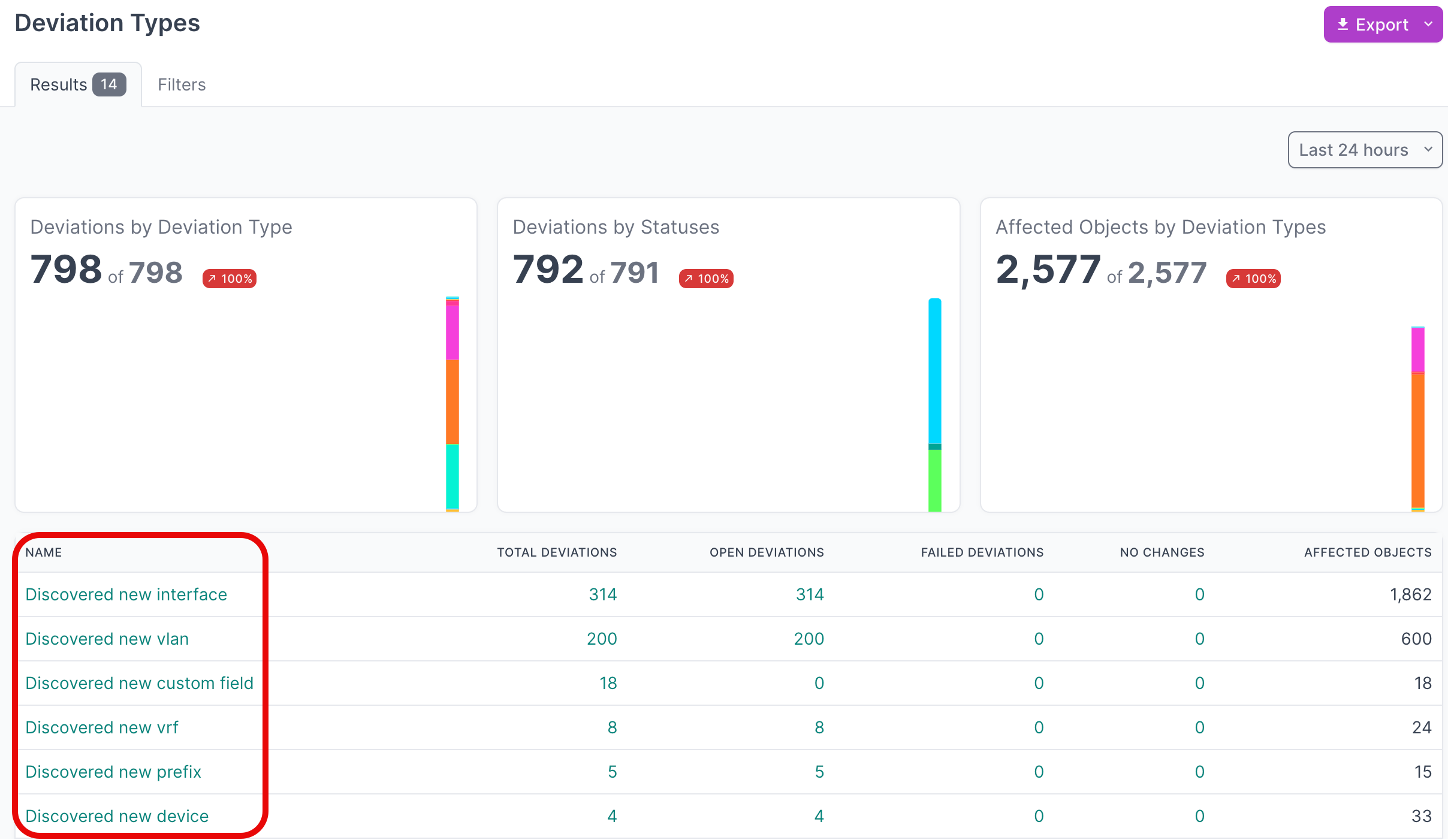
- Click on Deviation Types to view the categories of deviations discovered.
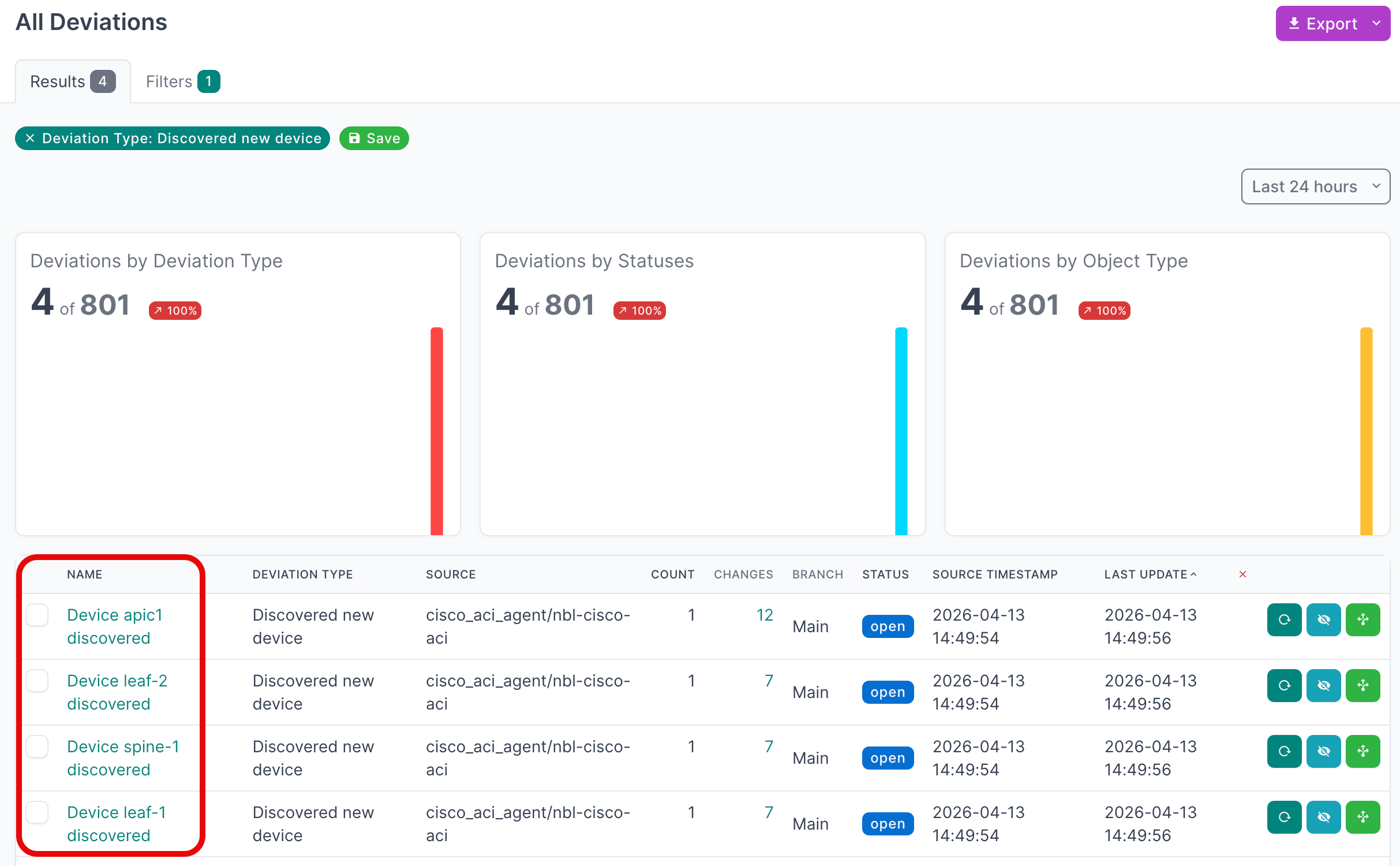
- Click the Name of a deviation type to view deviations of that type.
- Click the Name of an individual deviation to view its details.
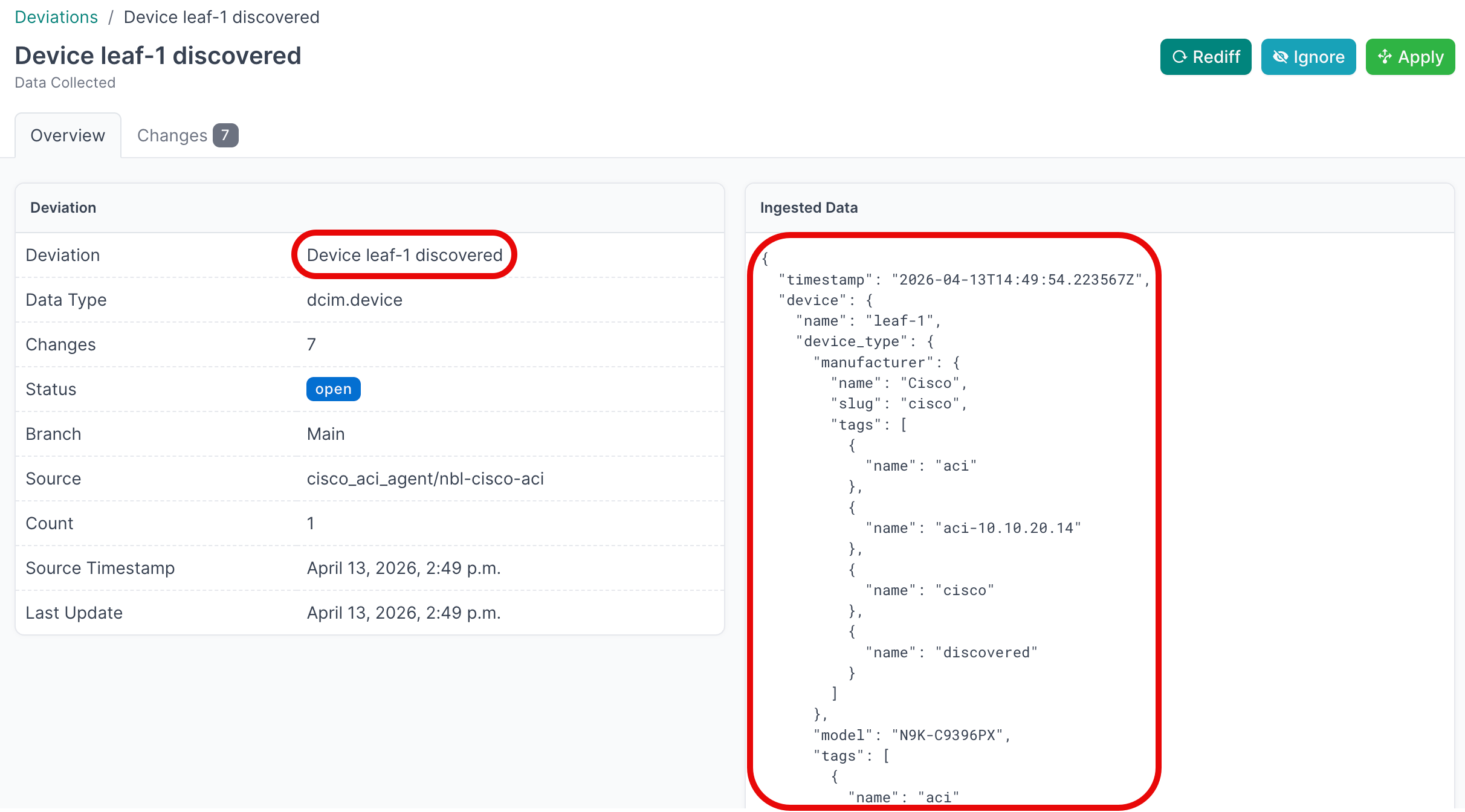
View Active Deviations
- Click on Active Deviations to view all deviations that have not yet been applied or ignored.
- Click the Name of a deviation to view its details.
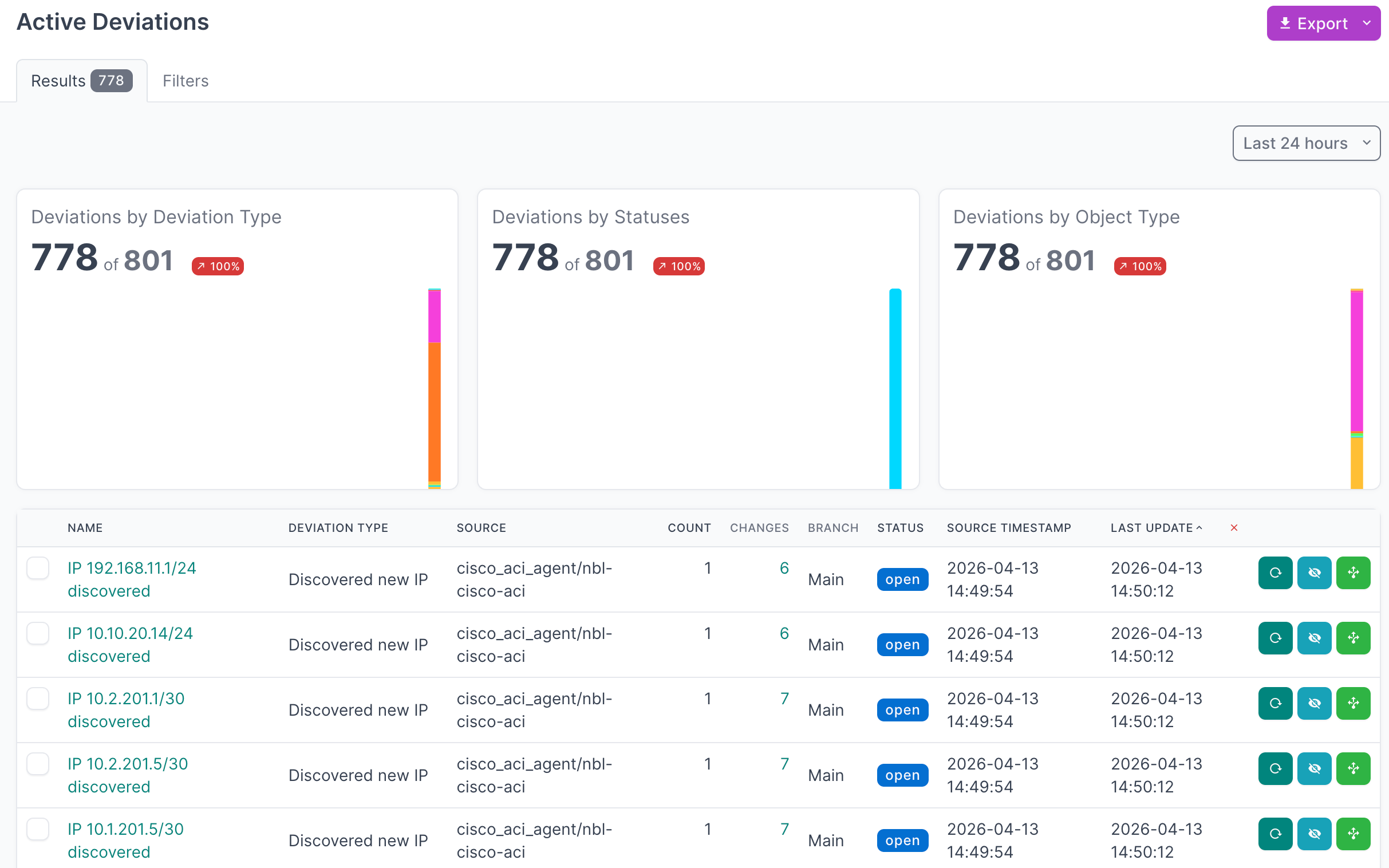
Apply Deviations
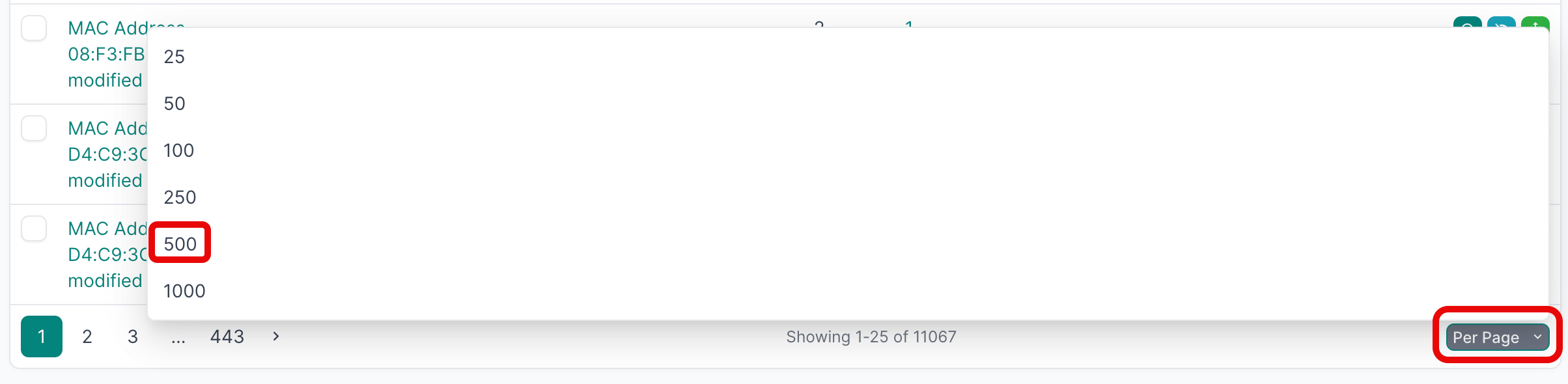
- Select the deviations you want to apply. For large result sets, set Per Page to 500 first.
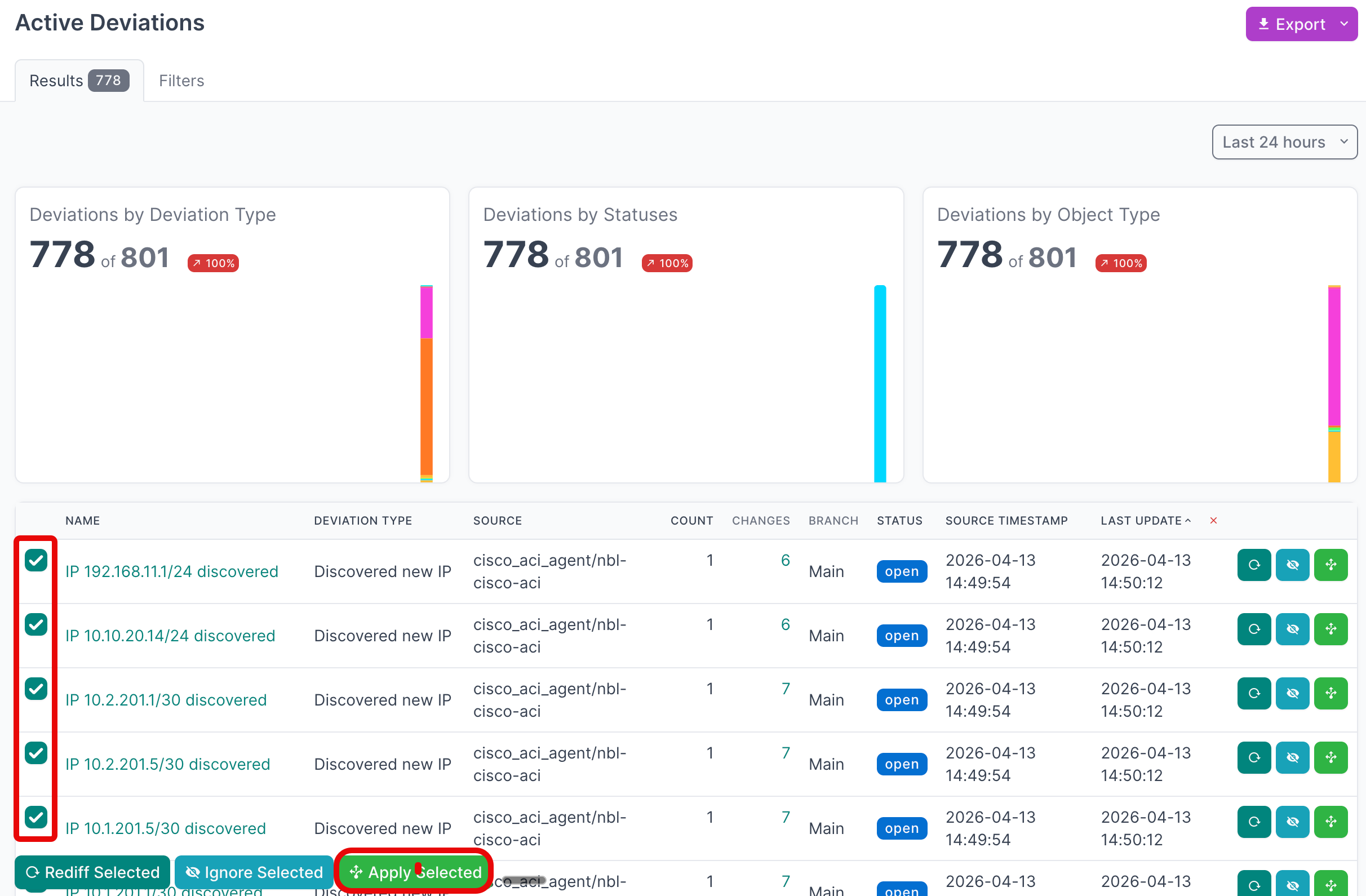
- Select the first deviation, hold
SHIFT, select the last one, then click Apply Selected.
- Click Apply X Deviations to write the data to NetBox.
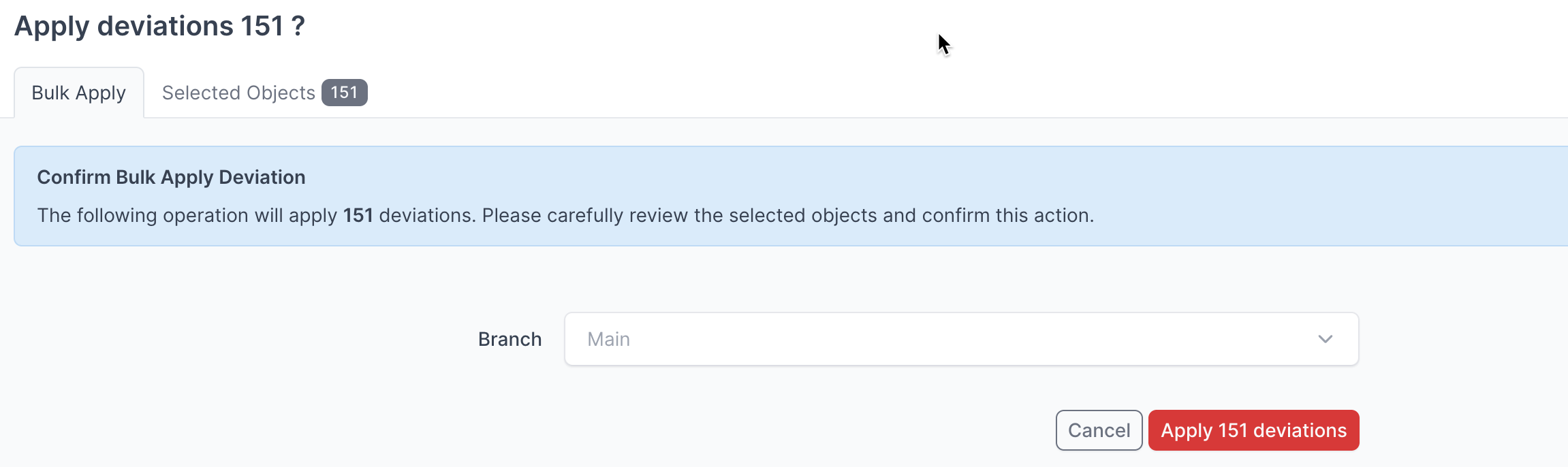
Instead of writing deviations to the Main NetBox database branch, select another branch from the drop-down menu to apply deviations to that branch first.
For detailed information on working with NetBox Assurance, see the documentation.
View the Cisco ACI Data in NetBox
After running the integration and applying discovered data, you can navigate the ACI inventory in NetBox:
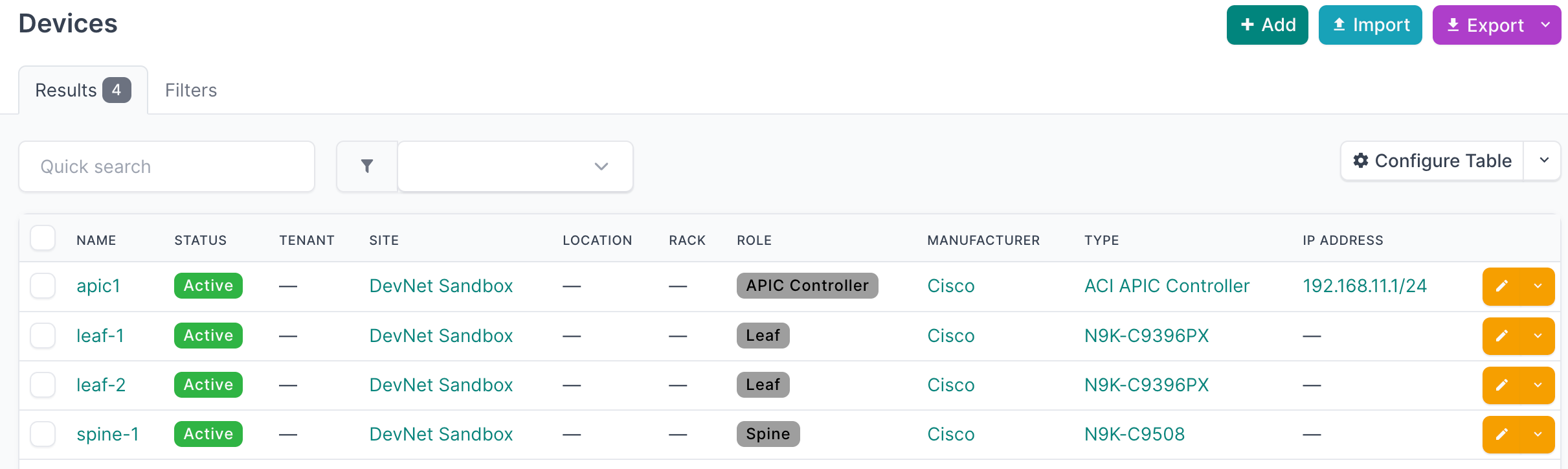
- Click on Devices in the main navigation menu to view discovered APIC controllers, spine switches, and leaf switches.
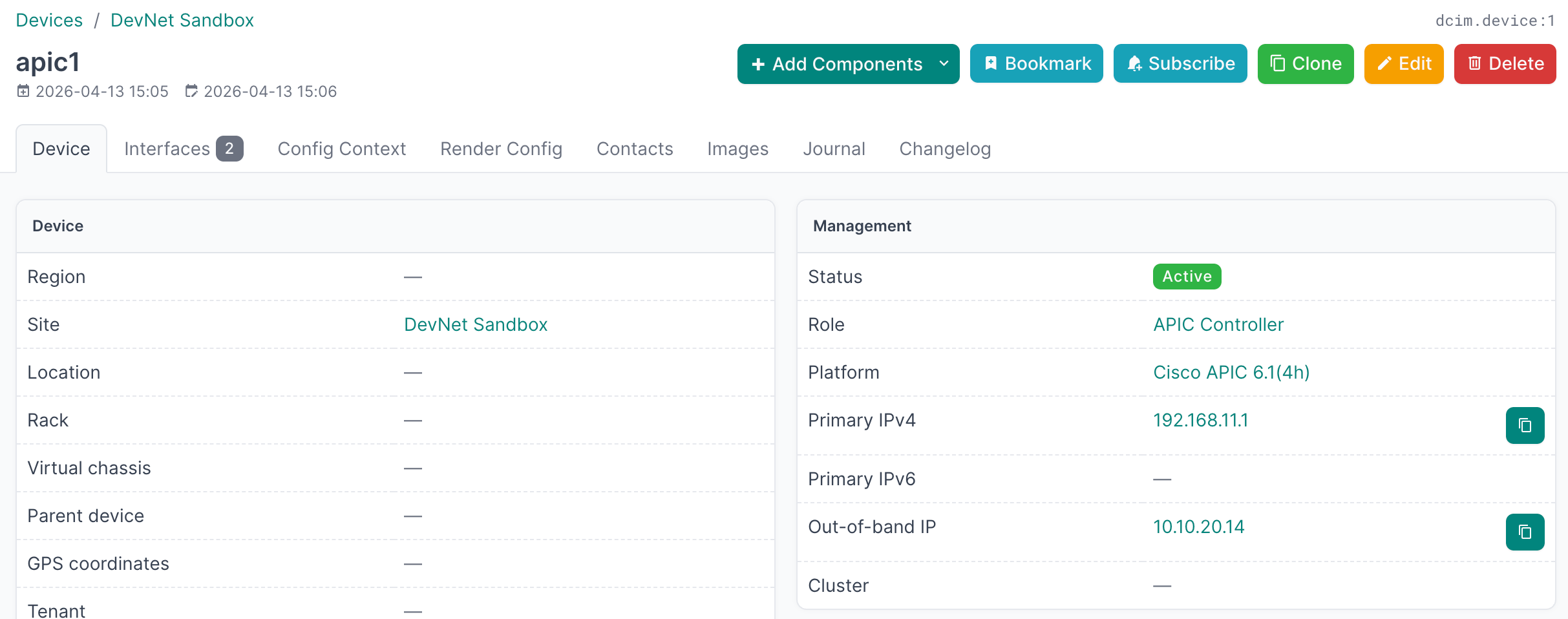
- Click on a device to see its interfaces, IP addresses, and ACI-specific custom field values (pod, node ID, fabric).
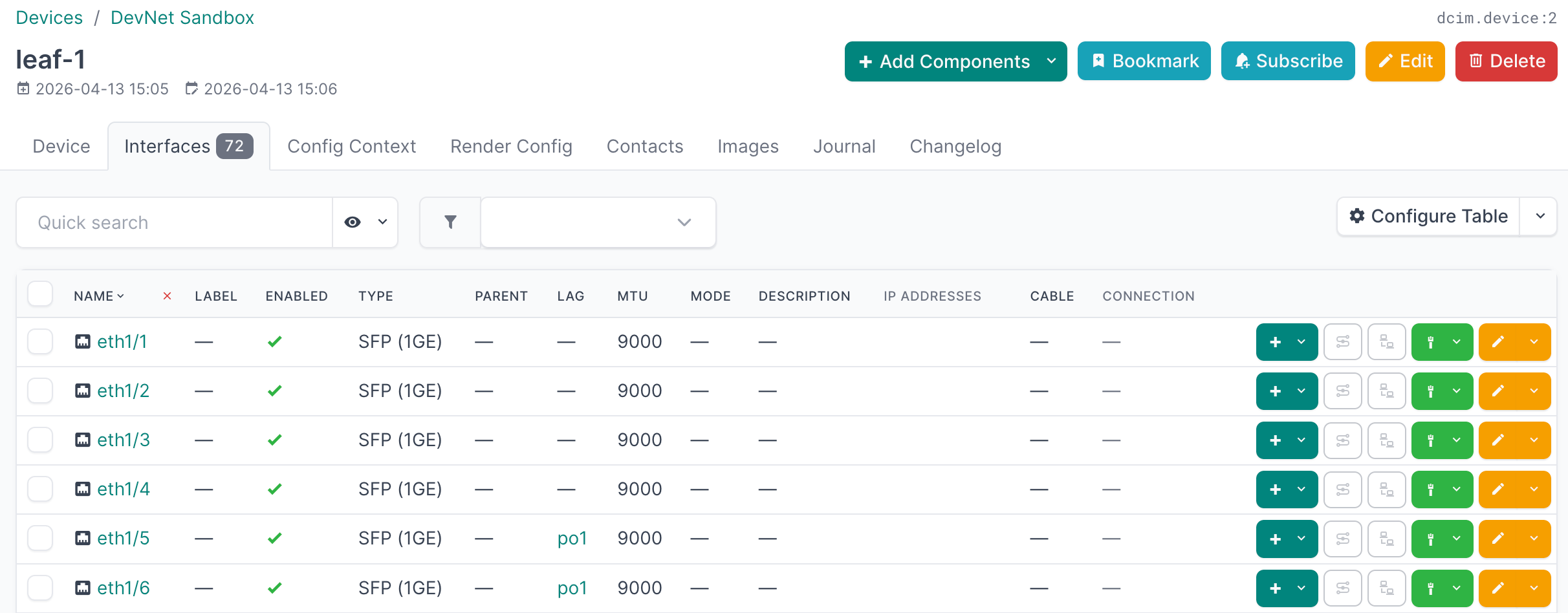
- Click on Interfaces on a device to see physical interfaces, LAG/vPC aggregates, SVIs, and management interfaces.
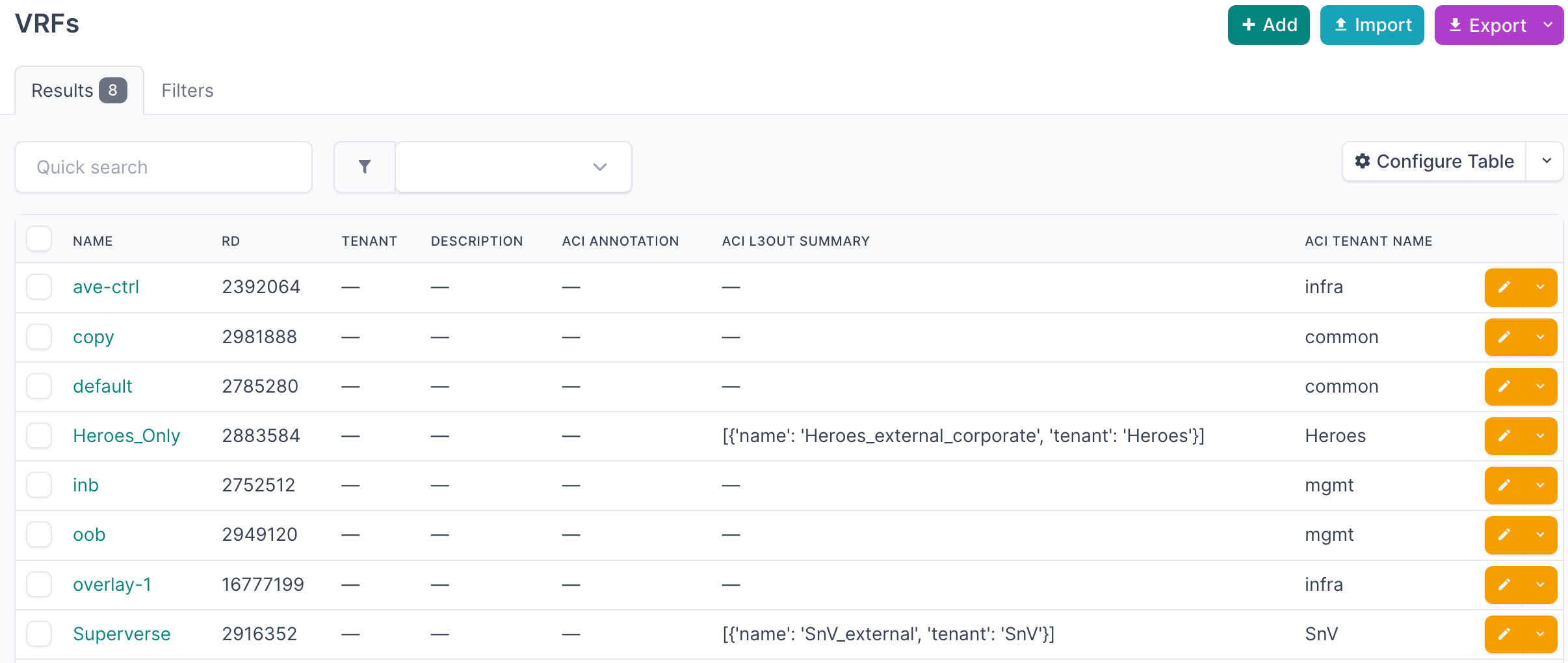
- Click on IPAM → VRFs to view tenant VRF contexts discovered from the fabric.
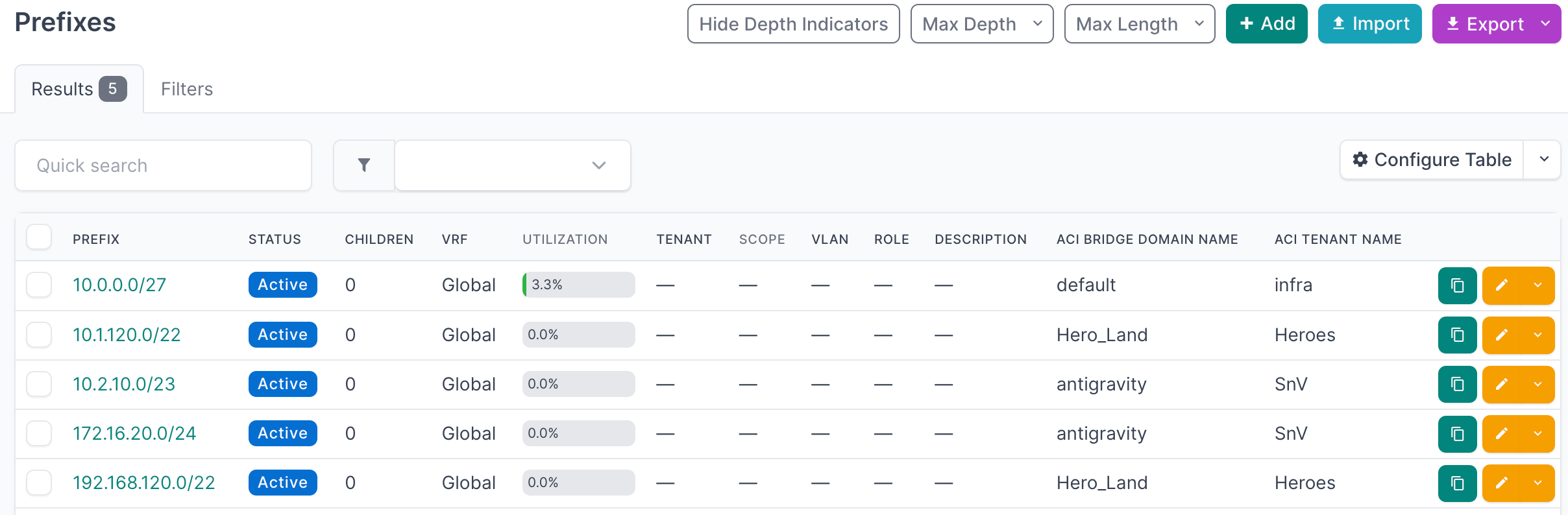
- Click on IPAM → Prefixes to view bridge domain subnets and L3Out external subnets.
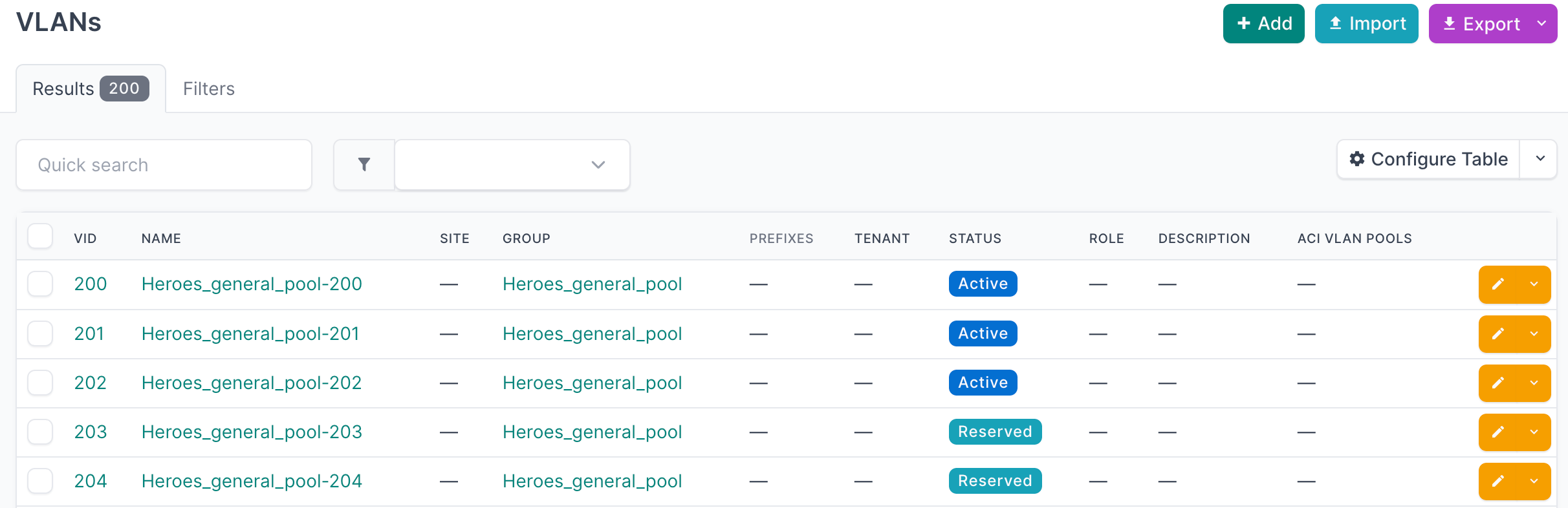
- Click on IPAM → VLANs to view VLANs discovered from static bindings and L2/L3Out attachments.
Additional Resources
Related Documentation
- NetBox Assurance Documentation
- Orb Agent Documentation
- Cisco ACI Integration - Technical Information
Support
Email support@netboxlabs.com for support.