New Integrations Extend the NetBox Labs Platform Across the Full Infrastructure Stack
Enterprise network teams run automation off their system of record. But when large portions of the infrastructure live in separate tools that were never designed to talk to each other, you get blind spots that break automation. Outage investigations stall while engineers pull data from four different systems. New site deployments take weeks of manual data entry before a single playbook can run.
The NetBox Labs platform now spans the full infrastructure stack: enterprise wireless, WAN circuits, IPAM and DHCP, data center fabric, virtualization, and ITSM. That means teams can discover, validate, and automate across every layer of their infrastructure from one place.
Today, we’re shipping two new generally available integrations, HPE Juniper Networking Mist and Lightyear, and opening customer preview for two more, Infoblox NIOS and Cisco ACI. Together they cover four infrastructure categories that were previously manual-entry for most teams.
Every one of these integrations flows through NetBox Assurance. Discovered data arrives as deviations, not direct writes. Your team reviews what changed, decides what to apply, and can branch changes before committing to production. No data lands in the NetBox Labs platform without explicit approval.
HPE Juniper Networking Mist Integration
Built through a partnership between HPE and NetBox Labs, the HPE Juniper Networking Mist Integration automatically discovers and synchronizes Mist-managed network infrastructure into the NetBox Labs platform. The integration brings enterprise wireless and campus switching into the NetBox Labs platform automatically, offering extensive object coverage across network devices and infrastructure.
For organizations running HPE Juniper Networking Mist, this means their Mist inventory and its operational state become a first-class part of the infrastructure record, tagged, queryable, and available to every downstream automation workflow.
A typical Mist deployment may surface thousands of new objects across dozens of sites on first run. NetBox Assurance, a part of the NetBox Labs platform that enables continuous validation of your infrastructure’s operational state against its intended state, lets teams apply changes in batches, scope them to a branch, and verify before promoting to main. Bootstrap mode creates all necessary custom fields, manufacturers, and tags automatically before any data is ingested.
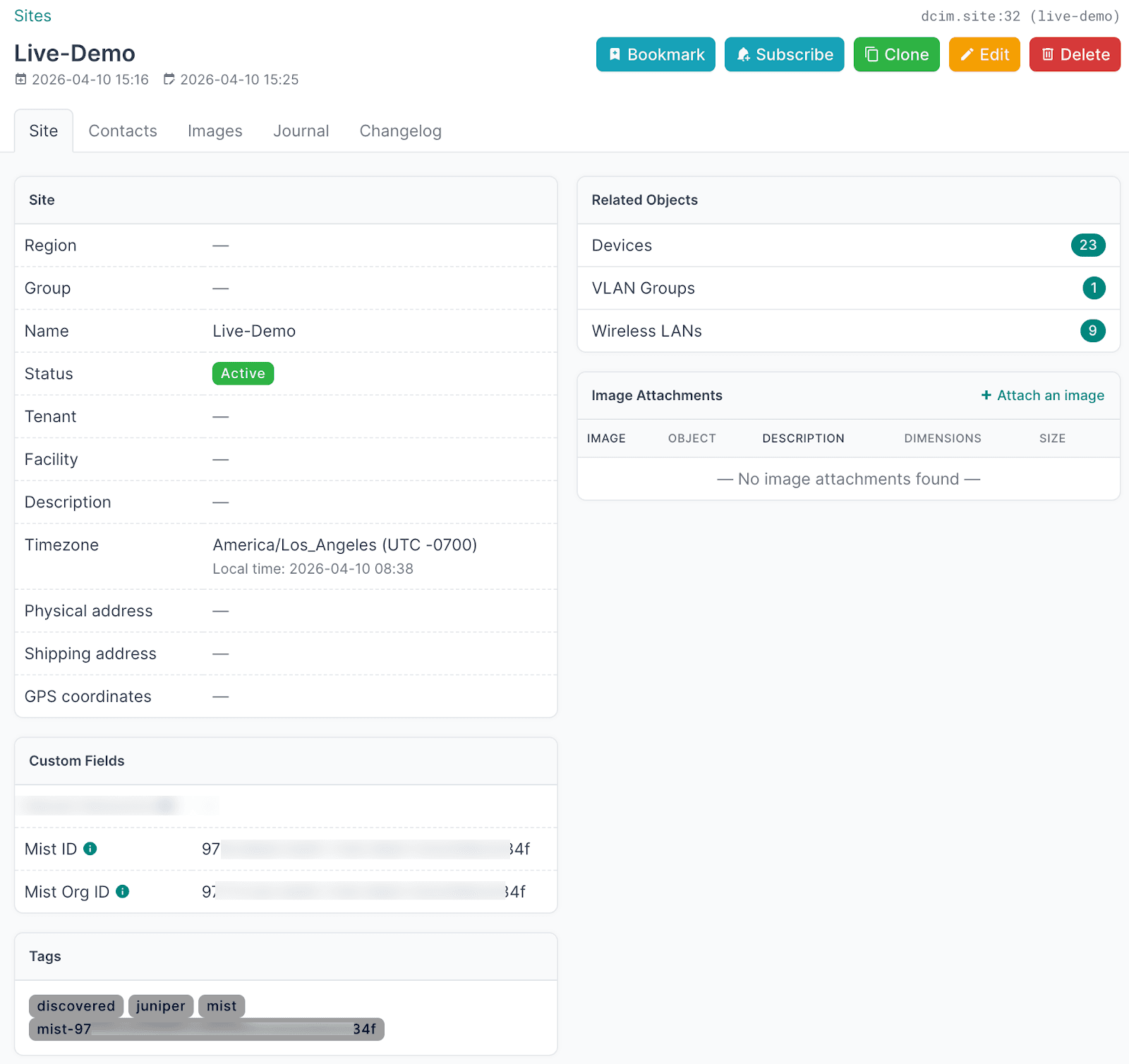
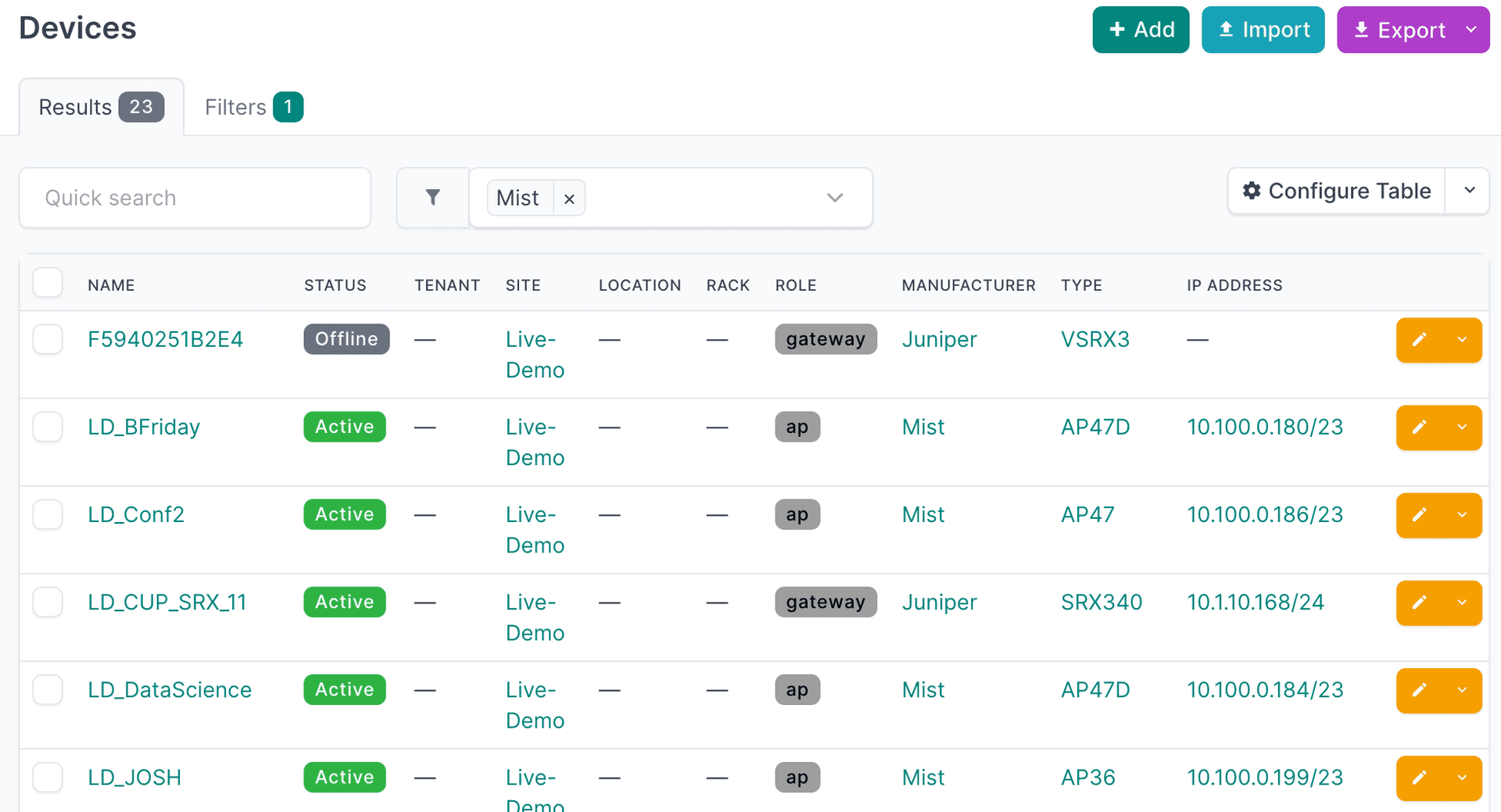
A lightweight Docker-based agent connects to the HPE Juniper Networking Mist Cloud API and ingests your entire Mist-managed estate via NetBox Assurance.
- Sites
- Devices including APs, switches, gateways, and Virtual Chassis stacked switches
- Interfaces, IP Addresses, and MAC Addresses
- VLANs
- Wireless LANs including SSIDs, authentication type, and WLAN-to-device mapping
- Platforms, Device Roles, and Device Types derived automatically from Mist device type and firmware version
The deployment footprint is a single Docker container with a YAML config file. The agent supports all HPE Juniper Networking Mist cloud environments globally and requires only outbound HTTPS access. No inbound ports, no firewall changes, no custom code. Teams running multiple Mist Organizations can deploy separate agent instances per org, with scope filtering to limit sync to specific sites.
Lightyear Integration
HPE Juniper Networking Mist covers the device layer. But an infrastructure system of record also needs to know about the circuits connecting those devices and sites.
Born out of a formal partnership between NetBox Labs and Lightyear, this integration automatically synchronizes circuit inventory from Lightyear.ai into the NetBox Labs platform. Lightyear manages over 1,200 telecom vendors and handles circuit procurement and lifecycle management for enterprise networking teams. The integration bridges that procurement intelligence with NetBox Labs’ circuit data model, synchronizing circuit types, providers, provider accounts, and full circuit records including service IDs, status, installation dates, and termination dates.
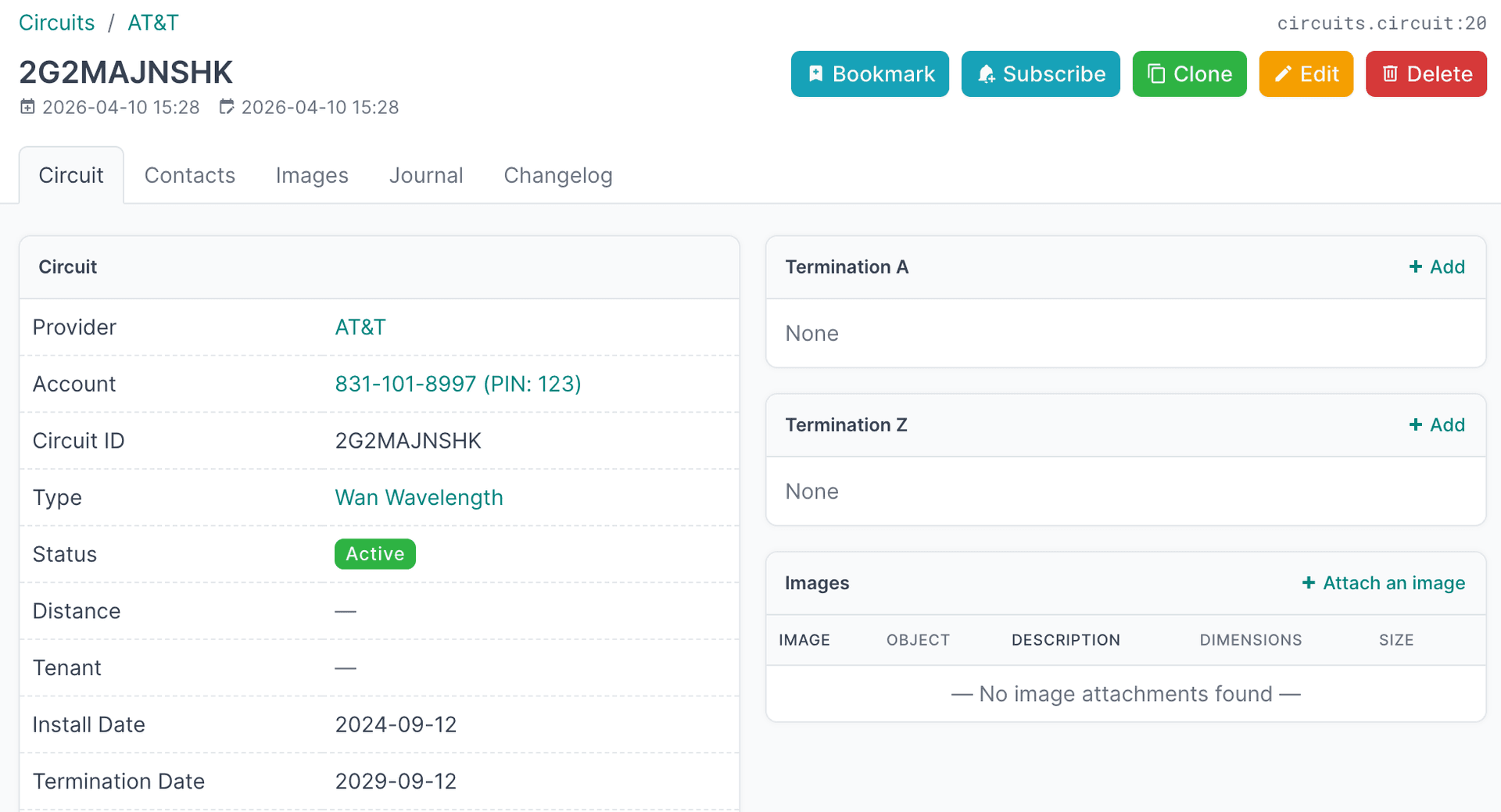
A two-phase API fetch retrieves both summary and detailed service data for complete records. Lightyear statuses map automatically to NetBox Labs circuit statuses. All objects are deduplicated by slug or composite key, so the integration is safe to re-run without creating duplicates.
The result: Lightyear remains the system of record for procurement and vendor management, and the NetBox Labs platform relates those circuits to the devices, sites, and IP addresses they serve. Both systems stay accurate without manual reconciliation.
Now in Customer Preview: Infoblox NIOS and Cisco ACI
Alongside the two GA launches, NetBox Labs is opening customer preview for integrations targeting two more foundational infrastructure categories.
The NetBox Labs Infoblox NIOS Integration eliminates the manual work of maintaining parallel IP address inventories. A Docker-based agent connects to the Infoblox WAPI and synchronizes IPv4 and IPv6 networks, IP addresses from DHCP leases and fixed reservations, DHCP ranges, and VLANs into NetBox. Network view scoping lets teams limit synchronization to specific Infoblox views for phased rollouts, and paginated WAPI reads are designed to support large-scale deployments with extensive subnet and address inventories.
The NetBox Labs Cisco ACI Integration discovers the full ACI fabric, controllers, spines, leaves, interfaces, VRFs, prefixes, VLANs, and IP addresses, and synchronizes it into NetBox with ACI-specific metadata preserved as structured custom fields. Tenant name, pod ID, node ID, bridge domain, and EPG static binding context are stored directly on NetBox objects, not flattened into notes or lost in translation.
Getting Started
These four integrations join existing connectors for Cisco Catalyst Center, Cisco Meraki, VMware vCenter, and ServiceNow CMDB, closing the gaps that used to require manual data entry between siloed infrastructure tools.
The HPE Juniper Networking Mist and Lightyear integrations are available now for NetBox Labs customers running NetBox Assurance. Infoblox NIOS and Cisco ACI are in customer preview. For technical documentation and detailed object mapping information, visit the integration docs for HPE Juniper Networking Mist, Lightyear, Infoblox NIOS, or Cisco ACI. To get started or request a walkthrough, contact NetBox Labs support at support@netboxlabs.com.
Not a current NetBox Labs customer? Contact us to learn more about the NetBox Labs platform.