How to Build Change Processes That Minimize Network Outages
You might already have planned your next major network outage.
Downtime incidents aren’t always the result of rogue engineers defying or ignoring network change policies. Outages can also happen when approved, scheduled changes meet corporate protocols but still fail to address potential pitfalls.
If a network professional can skip, misjudge, or override a control, it’s not really a control at all and your network is at risk of significant downtime. The potential for human error is just too great. As networks grow and change rapidly, the most effective checks in the planning process are those enforced by the system itself.
When change planning leads directly to downtime
Outages that result from planning problems aren’t rare. One CX principal speaking at Cisco’s Networking Industries webinar in October 2026 estimated that 20% to 25% of the cases reaching Cisco TAC trace back to faulty configuration pushed to devices. In pretty much every case, somebody approved the change that led to an incident.
A couple of incidents serve as cautionary tales. A routine firewall upgrade at an Australian telephony carrier stopped emergency calls from connecting for close to 14 hours. The calls were to Triple Zero, Australia’s equivalent of 911 in the US. According to an independent review, more than 450 people tried and failed to reach the number when the network was down. At the core of the outage was a change procedure that shut down key equipment without first redirecting calls.
The independent review found at least 10 mistakes in the planning process that led to the outage. For instance, the change was rated both low-risk and urgent, which meant it skipped senior review. And while alerts fired during the upgrade, engineers assumed they were false alarms.
Another notable incident involved Microsoft’s Azure Front Door, the global edge service in front of Microsoft 365, the Azure portal, and thousands of customer applications. In the incident, Azure Front Door failed worldwide for more than eight hours.
Azure Front Door had staged deployments and a dedicated configuration protection system. But after an incompatible configuration passed through the protection system cleanly and a delayed background processing task acted on it, a crash occurred and caused the outage.
Lessons from failed change planning
Network teams need to keep a couple of lessons in mind when planning and executing network changes:
- A person, no matter how well-meaning, can still override a working safeguard without anybody downstream knowing the gate is open.
- A pre-deployment check can’t catch a failure that only appears after deployment. Validation at the gate is necessary but not sufficient. Something has to verify the system after the change lands.
In addition, a few common issues are frequently present when planning processes break down:
- Success can lead to complacency. Fifteen clean firewall upgrades made the sixteenth look routine. Risk ratings drift downward when nothing has gone wrong lately. Attention slips, and the risk of downtime skyrockets.
- Overrides are invisible. A gate that one person can open without anyone else noticing is only as effective as that person’s judgment at any given time. Everybody makes mistakes.
- Checking stops at deployment. Engineers at the carrier thought the alerts were just noise from the change. Azure’s bad configuration passed the gate and failed later. In both cases, the moment after the change passed largely unmonitored.
Adding another approval signature won’t solve any of those problems. The only way to resolve the issues is to move the check out of someone’s head and into the system.
How to get enforced change control right
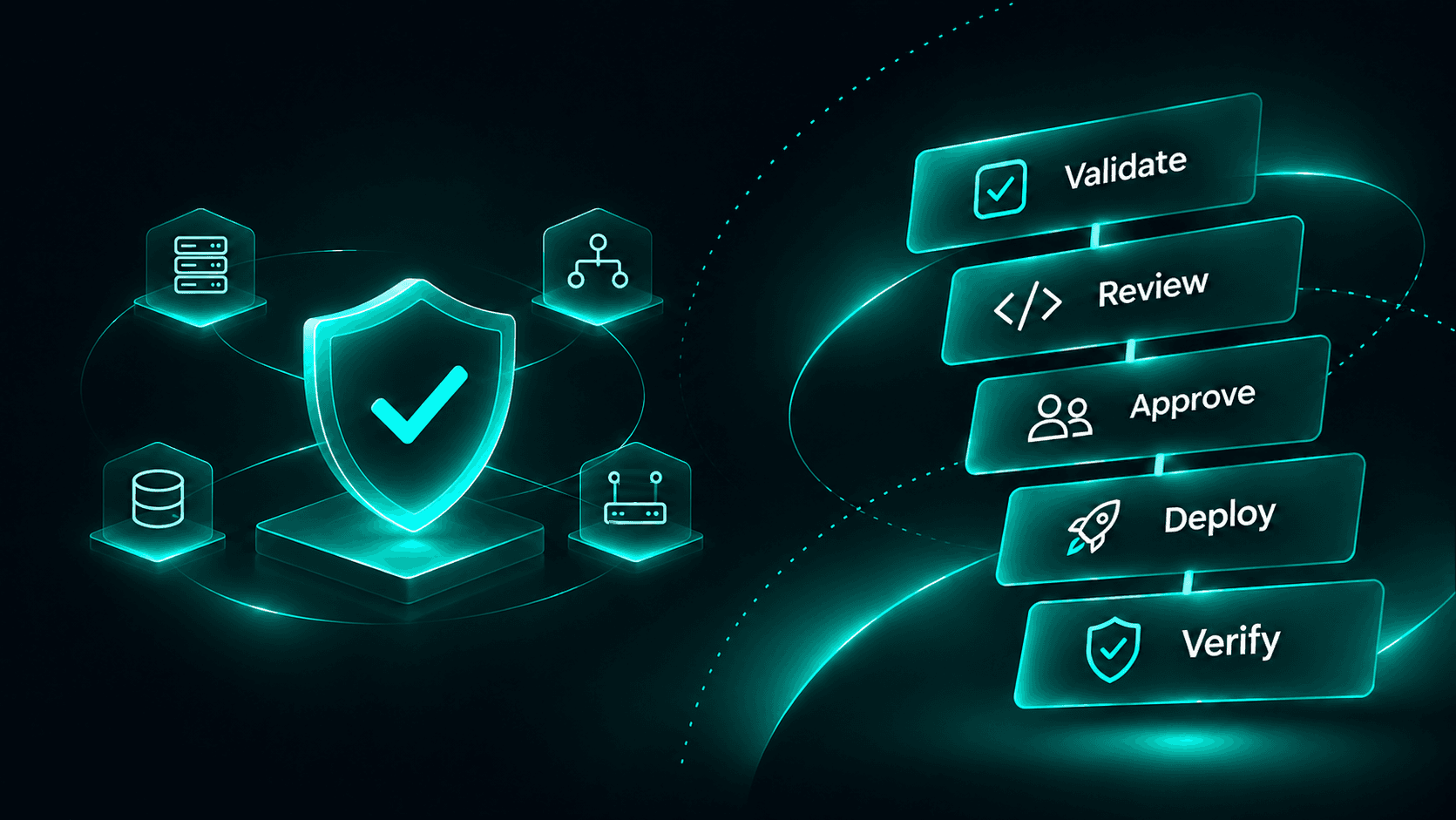
Instead of merely describing how to make a change, organizations need to declare what the network should look like and then let automation, such as Ansible, Terraform, Nornir, or a CI pipeline, enforce the rules. In practice, that means five things:
- Validate before anything touches the network. Check syntax (correct types, required fields) and semantics (unique names, VLANs in allowed ranges, no overlapping prefixes).
- Review the diff, not the description. A change request indicates what someone intends. A generated plan shows exactly what a change will create, modify, or delete. Base the risk rating on what the diff touches, such as routing policy, emergency call paths, or core firewalls, rather than on a label somebody typed.
- Separate proposing from approving, and make overrides loud. No entity, human or automated, should approve its own change. Emergency bypasses should exist, but they should be logged, visible, and reviewed afterward.
- Verify after deployment, and verify everything. Rerun the plan to confirm nothing is still pending. Then test the whole network’s intended state, not just the part you changed, so you catch collateral damage. Treat alerts during a change window as evidence, not noise.
- Keep the record honest. All of this assumes your system of record matches reality. Continuously compare intended state with what’s actually running, and resolve every gap one way or the other.
Where to start
You don’t need to rebuild your change process to make progress. Start with small, concrete steps:
- Audit your gates. List every check in your current process and mark which ones depend on a person remembering, judging, or noticing. Each of those is a candidate for automation.
- Pick one frequent change type. Branch onboarding and moving an access port to a new VLAN are good candidates. Encode its rules as tests and run them on every change.
- Make your system of record authoritative. Have the pipeline read from it at runtime instead of copying values into config files. In the Cisco webinar demo, IP prefixes owned by a separate team were pulled from the system of record into every pipeline run, so the network team never hard-coded an address.
- Put changes to the record itself under review. Data changes need the same discipline as config changes. Branching and change requests on the NetBox Labs platform let a team propose an update, review the exact diff, and require someone else to approve it before it reaches production.
After the next approved change, ask which parts of it could have been skipped without anyone noticing. Those are the parts to fix first.
How NetBox Labs can help
NetBox Labs builds the pieces that turn those steps into system-enforced controls:
- A system of record to create pipelines you can trust. The NetBox Labs platform holds the intended state of the network (devices, IP addresses, VLANs, wireless settings) and serves it to automation at runtime.
- Review and approval built into the record. Branching and change requests let anyone, including an AI assistant, propose a change and show the exact diff. A branch can’t merge without an approved change request, and approval policies can require sign-off from reviewers other than the requester. Approved, merged changes can then trigger the automation that pushes to the network.
- Verification after the change. NetBox Discovery and NetBox Labs integrations with controllers like Cisco Catalyst Center pull in what’s actually running; NetBox Assurance compares it with the intended state and flags where they differ, so teams can update the record or fix the network before the next outage.
Nobody plans to fail, but even the best set of plans has weaknesses. Moving change control away from fallible, human-centric processes and into an automated system can minimize the risk of catastrophic outages.
