AutoCon 4 Workshop Now Available for Self-Paced Learning
AutoCon4 Workshop: Closed-Loop Network Automation Now Available for Self-Paced Learning
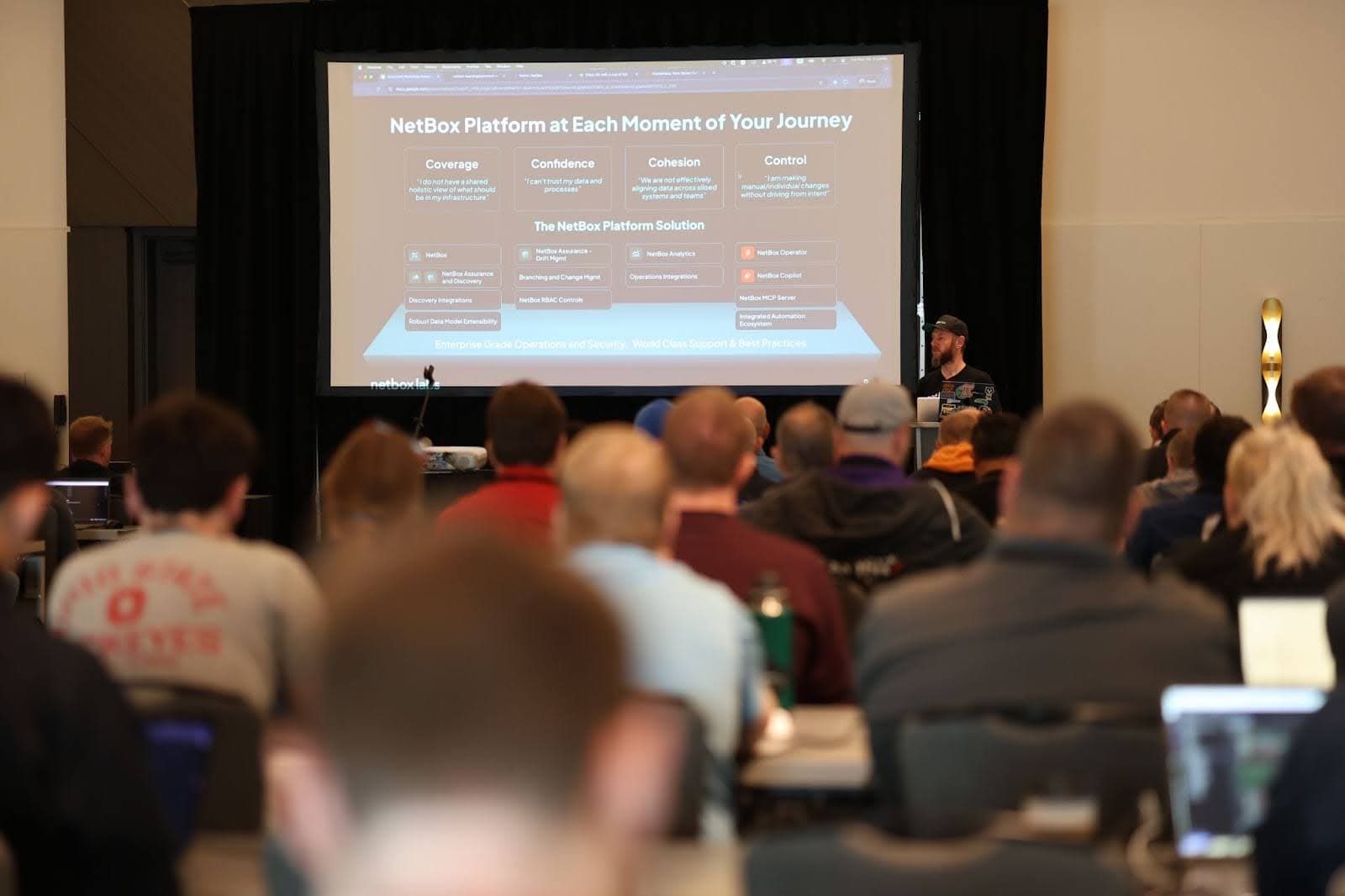
Last month at AutoCon 4 in Austin, we ran a hands-on workshop on building closed-loop network automation systems that detect and correct drift automatically – and the room was packed! The response and feedback confirmed there’s strong demand for practical guidance on implementing these systems, not just theoretical discussions.
Today I’m excited to announce that this workshop is now available for everyone as a self-paced learning experience. We’ve renamed it “Closed-Loop Network Automation: Zero to Hero” and published it on GitHub with detailed documentation to guide you through building your own self-correcting automation stack.
Building automation that heals itself
Whether you attended AutoCon 4 and want to revisit the material, or you’re just getting started with network automation, this workshop provides practical, hands-on experience with modern automation tooling. You’ll build a complete full-loop network automation stack using NetBox that self-corrects by managing operational drift.
Here’s the reality we all face: networks drift. Despite your best automation efforts, engineers SSH in to troubleshoot, emergency fixes bypass the proper workflow, and configurations gradually diverge from their intended state. This workshop shows you how to build automation systems that detect when reality doesn’t match intent, and how you can automatically fix it.
What makes this workshop different
This isn’t just another “deploy configs with Ansible” tutorial. We take you through the complete journey from manual configuration pain through to a fully functioning closed-loop system with feedback mechanisms.
The workshop uses a realistic network topology based on two Nokia SR Linux routers, complete with interface configuration, IP addressing and OSPF configuration. You’ll work through six progressive modules that build on each other:
Module 1: Manual Configuration – Experience the pain points that automation solves (router jockeys who’ve already spent too much of their life in the CLI, feel free to skip this one)
Module 2: Observability – Set up monitoring with Orb agent and Prometheus to detect failures automatically
Module 3: Discovery & Baseline – Use NetBox Discovery to automatically document your existing network
Module 4: Network Modeling – Model your intended network state in NetBox using branches, config templates, and config contexts
Module 5: Automated Deployment – Deploy configurations automatically with Ansible
Module 6: Drift Detection & Self-Healing – Detect configuration drift with discovery and automatically correct it
By the end, you’ll have a system where NetBox defines the desired state, Ansible deploys it, discovery validates it, observability monitors it, and the system automatically corrects drift. That’s true closed-loop automation.
An entirely open source stack
An important aspect of this workshop: everything you’ll use is open source or source-available. There are no commercial components or proprietary tools required. This means you can take what you learn and apply it directly in your own environment without licensing concerns or vendor lock-in.
You’ll work with:
- NetBox as your network source of truth
- NetBox Branching for safe change management
- Diode for network data ingestion
- Orb agent for discovery and observability
- Ansible for configuration deployment
- ContainerLab for network emulation
- Prometheus for metrics and alerting
- Gitea for Git-based configuration management of Orb agent
Get started now
You can get started right now by heading over to the autocon4-workshop directory in our netbox-learning repository.
The workshop is designed to be completed in 2-3 hours at your own pace, with the flexibility to pause and resume as needed. You’ll need a Linux environment (Ubuntu recommended) with at least 4 vCPUs and 8GB RAM. All tooling runs in containers and our setup scripts handle most of the complexity.
We encourage you to reach out if you have questions or ideas in the #netbox channel in the NetDev Slack. If you’re not already a member, you can join here.
The workshop is open source under the Apache 2 license and we encourage you to use it, fork it, and extend it for your own automation workflows. We’re looking forward to hearing what you get out of it!
—
If you’re interested in other NetBox automation patterns, check out our AutoCon2 workshop which covers complementary topics like monitoring with Icinga and configuration assurance with Netpicker.