GraphQL API
The NetBox Custom Objects plugin exposes custom objects through NetBox's GraphQL
API at the standard /graphql/ endpoint, alongside NetBox's built-in models. For
each Custom Object Type you have defined, two root query fields are generated:
<name>- fetch a single custom object byid.<name>_list- fetch a list of custom objects (paginated).
The <name> is custom_objects_<slug>, where <slug> is the Custom Object
Type's slug with any characters that are not valid in a GraphQL name replaced
by underscores (for example a type with slug dhcp-scope becomes
custom_objects_dhcp_scope and custom_objects_dhcp_scope_list).
The custom_objects_ prefix namespaces these fields so they can never collide
with NetBox's own (or another plugin's) root query fields - every plugin's
GraphQL query is merged into NetBox's single global Query, so a bare,
slug-derived name like site or group would otherwise be shadowed by a core
model's field.
Authentication
GraphQL requests use the same authentication as the REST API. Pass a token in the
Authorization header:
Authorization: Token <your-api-token>Object-level permissions are enforced. The top-level <name> / <name>_list
queries only return custom objects the authenticated user has permission to view,
and objects reached through a relationship field are likewise filtered to those
the user may view.
Using the GraphiQL explorer
NetBox's built-in GraphiQL explorer (at /graphql/) loads the GraphQL schema
once when the page opens and caches it for the life of the page. Because
custom object types and their fields can change at runtime, the explorer's
autocomplete suggestions and Documentation panel can go stale.
If you add, remove, or change a custom object type's fields, or add a new custom object type, while GraphiQL is open, those changes will not appear in the field autocomplete or the Docs panel until GraphiQL re-reads the schema. (The change is already live on the server - a query using the new field works immediately - it is only GraphiQL's cached copy of the schema that lags.)
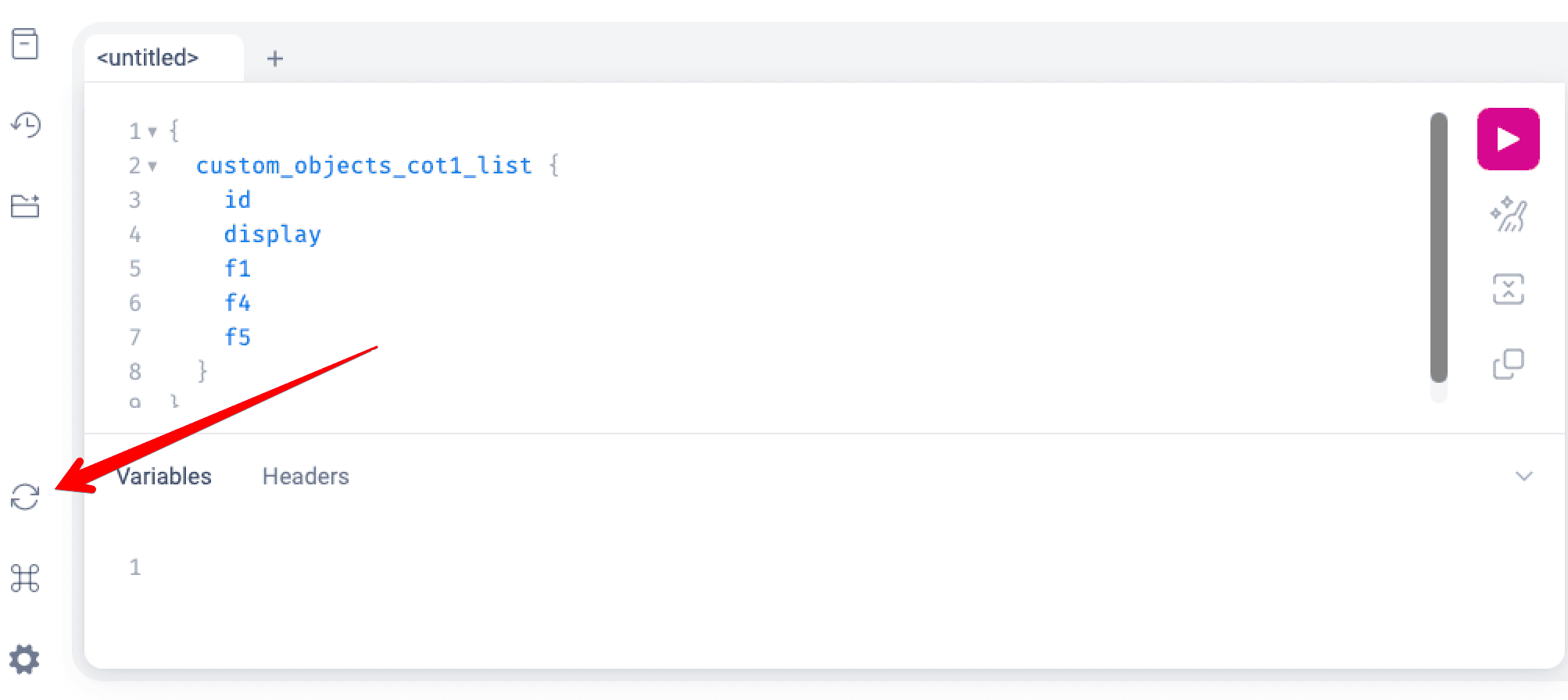
To refresh it, click the Re-fetch GraphQL schema button - the circular-arrow icon in the GraphiQL toolbar (lower left). This re-reads the schema without reloading the page, so your current query is preserved:
Reloading the whole browser page has the same effect, but discards whatever you have typed in the editor.
This only affects the interactive explorer. Programmatic API clients fetch the schema via introspection whenever they choose, and always query against the current server-side schema.
Querying a list
The fields you can select depend on how the Custom Object Type is defined. Every
type exposes id and display; the examples below also assume the type defines
custom fields named name and description.
query {
  custom_objects_dhcp_scope_list {
    id
    display
    name
    description
  }
}
Tip:
displayis the only human-readable field guaranteed to exist on every type - it is the value of the type's primary field.nameexists only if the type defines a custom field literally namedname.
Querying a single object
query {
  custom_objects_dhcp_scope(id: 42) {
    id
    display
  }
}
Available fields
Each generated type exposes:
| Field | Description |
|---|---|
id | The object's primary key. |
display | The object's display string (its primary field value). |
created / last_updated | Change-logging timestamps. |
tags | The object's tags. |
| One field per custom field | Named exactly as the field's name. |
Scalar field types
Scalar custom fields map to their natural GraphQL types:
| Custom field type | GraphQL type |
|---|---|
| text, long text, URL, select | String |
| integer | Int |
| decimal | Decimal |
| boolean | Boolean |
| date | Date |
| datetime | DateTime |
| JSON | JSON |
| multi-select | [String] |
Relationship field types
Object and multi-object fields resolve to the native GraphQL type of their
target, so a related object is fully traversable exactly as it would be when
queried directly. A field pointing at a Site resolves to NetBox's SiteType:
query {
  custom_objects_server_list {
    name
    primary_site {          # an object (single) field → SiteType
      id
      name
      region { name }       # traverse into the related object's own fields
    }
    interfaces {            # a multi-object (list) field → [InterfaceType]
      id
      name
    }
  }
}
Polymorphic fields
A polymorphic relationship field may point at several different model types. It resolves to a GraphQL union of those types; select fields per type with inline fragments:
query {
  custom_objects_binding_list {
    name
    target {                # polymorphic object field
      ... on SiteType { id name }
      ... on DeviceType { id name }
    }
  }
}
Fallback for targets without a GraphQL type
A small number of NetBox models are not exposed in GraphQL. When a relationship
field's target has no native GraphQL type, that field falls back to a uniform
CustomObjectRelatedObjectType so it is never silently dropped:
| Field | Description |
|---|---|
id | The referenced object's primary key. |
object_type | The referenced object's type, as <app_label>.<model>. |
display | The referenced object's display string. |
url | The referenced object's absolute URL, if resolvable. |